A Review of Esther Perel’s ‘Where Should We Begin?’ Game of Stories
“Stories are the bridges that connect us to other humans.“
-Esther Perel
Sharing the Love
We’d love to share the love with you by sending the game to you for FREE. Enter below for the giveaway. If you’ve got any questions/suggestions feel free to email us at info@lovita.blog We hope you enjoy reading this review!

How often do you find yourself at the dinner table – conversation in a lull? Or perhaps you’ve known your friends for a long time, but do you think you know them well? Or sometimes you’re just looking for ways to deepen the connections between you, your partner, or your family, but you don’t know where to begin…
Ansh and I have found ourselves in all of these situations. Over the years we’ve tried everything from Table Talk Dice, to Cherish Time and Love Stretching exercises. Each has helped, and yet variety is the key to vitality.
That is how I found myself clicking ‘add to cart’ on Esther Perel’s game – Where Should We Begin – A Game of Stories.
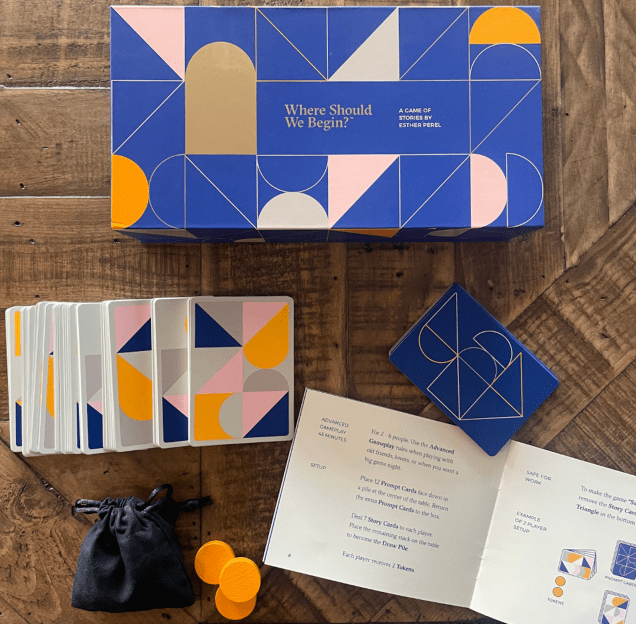
Overview:
Where Should We Begin is a thought-provoking and engaging game that sparks meaningful conversations and connections. Esther Perel’s expertise shines through in the carefully crafted questions and prompts on the cards. Playing with my partner led to unexpected discoveries and deeper understanding. The game is easy to learn, and the prompt addition adds a fun element. It’s a great way to strengthen relationships with friends, coworkers, or your partner. Highly recommended for anyone seeking to enhance their connections and communication skills!
We’ll be sharing a detailed review of our experience playing the game below but here’s a high-level take on it.
LoVita Hearts 5/5

Who’s this for
For anyone wanting to build healthier relationships with their friends, colleagues, and partners.
Cost
$40 on Amazon
Alternatives
Download and print a list of ice-breaker questions online to make your version.
Our experience
I came across the game on Esther Perel’s Instagram feed. If you don’t know about her already – Esther Perel is a Belgian author, psychotherapist, and relationship expert who has gained international recognition for her work on human relationships, intimacy, and sexuality. Along with writing several best-seller books, she hosts a popular podcast called “Where Should We Begin?” (which is our go-to on long drives). Naturally, a game endorsed by Esther was worth trying.
Set-Up
Esther does a fantastic job providing simple and easy-to-follow instructions for gameplay and videos that you can access via a QR code for a quick demo of the game.
The first time we played, we followed Version 1, or the simple gameplay in which we dealt 7 story cards to each player, picked who would be the storyteller first, and then placed one card face down in the middle of the table from our hand.
Here’s an example of how the cards from a round:

The point is: that when there are more than two players, the storyteller will shuffle the card options – read, and pick one that they wish to answer. After they are done answering, the center pile is discarded and you move clockwise to the next player.
Gameplay: The game consists of story cards, and prompt cards (or dice in the newer version). The story cards provide prompts for the storyteller (one player each round) and the prompts provide different lenses or perspectives to take into account for sharing a story.
I loved the card-based approach to storytelling, and figured if nothing else – I’d get a few insightful prompts to use in opening up my conversations with Ansh and good friends.
The combination of story cards and prompts means regardless of how many times you play, you’ll always have a new combination of prompts and lenses, encouraging you to share new stories.
We bought the original version of the game which uses tokens, story cards, and prompt cards. Since then, a 2nd version of the game has been released – with a dice instead of prompt cards. The dice provides different perspectives, and tokens can force a player to answer a specific story card, each token can only be used once.
Pros and Cons:
Our top pros and cons about why you would consider getting this game.
Pros
- Thought Provoking Questions
- Great for self-reflection
- Adaptable to different social contexts
Cons (Drawbacks)
- Restrictions with fewer players
- Limitations of Prompt Cards
Thought-provoking questions: The thoughtful curation of questions covers a spectrum of topics, from lighthearted anecdotes to deep and reflective conversations.
Great for self-reflection: It’s a great exercise to remember and reflect on your own stories, when you get a chance. You can just pick a random card from the deck and it makes you think about your life and choices. Although it’s always more fun to share your stories and listen to other’s stories, the cards can be used as a great tool for reflection.
Adaptable for different social contexts: Whether played between couples seeking to strengthen their bond, friends looking to deepen their understanding of each other, or co-workers aiming to foster better communication, the game provides a versatile platform for connection.
Restrictions with fewer players: When playing with friends, it makes more sense to follow the rules of submitting cards and picking one to answer. However, when there are only two players, like you and your partner or close friend, it’s a bit more fun for both players to answer the question. We also found that it doesn’t make as much sense to submit a card into a pile and then pick one – because with only 2 options, one being yours, it’s pretty easy to know whose card is whose. At that point, the game becomes a list of just ice-breaker questions that you can find online.
Limitations of Prompt Cards: I found that the prompt cards were both useful but also constricting. They were useful in helping to narrow down the scope of story possibilities, but constricting because now you have to filter my memories from a certain perspective. I get the idea of providing a specific lens, but I’d use it as a nice to have, not need to have for gameplay.
In-Depth Analysis:
The colors and feel of the packaging are very inviting. The game consists of 200 cards and a diverse range of prompts to create variations you won’t run out of. The cards are beautifully designed, capturing the essence of Esther Perel’s expertise in relationships and interpersonal dynamics.
The tokens brought an interesting twist to the game; now instead of it being the storyteller’s choice to answer any card, using your token you can nudge the conversation in a specific direction. A version of this that I would love to try is where everyone can put their token, on one or more card choices on the table; think of it like adding social points to the card choices – and at the end of the turn we all get our tokens back to reuse for the next person/turn.

The newer version of the game comes in pocket-size, travel-friendly packaging, which I think can be a great game to pull out instead of your phone, when in public.
LoVita Hearts (Recommendation)
This game received 5 out of 5 hearts from us. We’d highly recommend it – for anyone looking to build healthier relationships with their friends, colleagues, and partners.
Conclusion
Esther Perel’s approach encourages open dialogue and vulnerability, creating a safe space for players to share their thoughts and feelings. This makes the game an excellent resource for couples looking to strengthen their emotional connection and navigate challenges together.
When all is said and done, I think Where Should We Begin – A Game of Stories is an incredibly versatile, and well-designed game that expands easily to meet the needs of the audience. Amazingly, the game can be converted to a version that is even safe for work (by just removing all the story cards with a pink triangle!)
It’s obvious that with multiple variations, versions, and gameplay setups this game can easily incorporate homegrown modifications as well (strip storytelling anyone?), or the story cards can simply be leveraged to add a little levity to your next dinner table conversation.
We use the cards on almost a daily basis now as conversation prompts during meals at the dining table. It’s easy to get bogged down conversing about the day-to-day. This game helps you break that routine and practice vulnerability with others to build healthier relationships with whomever you play with.
To stay tuned and be the first to know about our future free giveaways of sharing the love, follow us on our social media channels, and subscribe to our newsletter.
About the Author
Raashi: She loves synthesizing ideas & bringing insights into the conversation. Learn more About Us
Disclaimer: This blog may contain links to affiliate websites, and we receive an affiliate commission for any purchases made by you on the affiliate website using such links. We are not affiliated with the products or services that we review and are not paid or otherwise compensated for sharing the information. The content here are solely views and opinions of the author. Review our full disclaimer for more information.
 LoVita