Friends are great sources of inspiration when it comes to Love Vitamins. Our first podcast guests and amazing best friends Guneet & Ankit shared a practice called End of Week Cuddle (what a cute spin on end-of-week huddle!).
On their recent trip to visit us, we had the chance to share in their End of Week Cuddle Tradition, and it reminded me a lot about how Ansh and I Debrief at the end of a trip. Debriefs like their End of the Week Cuddle is a check-in practice for Partners to talk about what can go unspoken in a relationship. It’s an intentional space to reset the emotional barometer, to appreciate the good, and to take note of where there is still work to do.
Essentially, at the end of the week, they take a moment to reflect on what happened during the week, what went well, and what they want to work on.
Two important distinctions they made – that I LOVED – were to focus on the whole week, not just the weekend and to focus on what they could do better, not what didn’t work during the week.
The first distinction, focusing on the whole week, enables them to take into consideration the work week and the weekend, instead of just focusing on a few major highlights or feeling like the week is about work and the weekend is about play.
The second distinction, focusing on what they want to work on and what they can do better rather than what didn’t go well during the week enables them to keep a positive, progress-oriented spin on what they can do to continue creating forward momentum in their relationship rather than get bogged down with the doldrums of what isn’t right (which as we all know is very easy to do!)
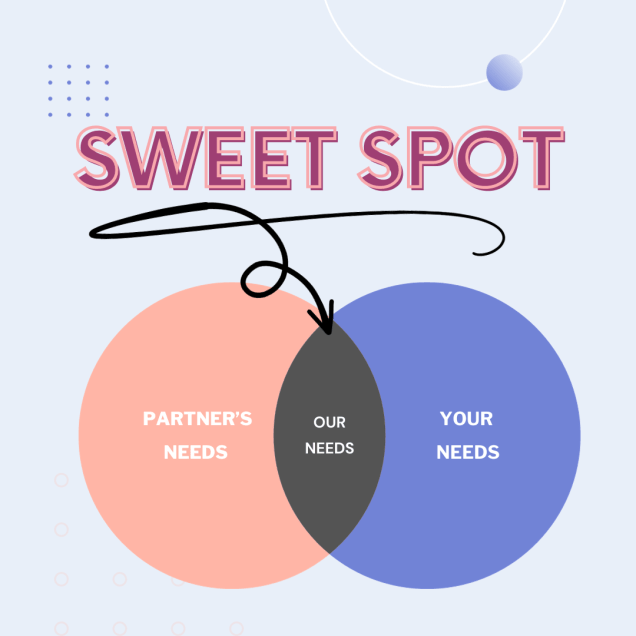
In a relationship, both you and your partner have individual needs, the Sweet Spot in a relationship consists of the needs you share in common. Heather Claus and I talked about this in more detail in our podcast interview, but essentially: my partner may love to go hiking, run marathons, and play pickleball – and I on the other hand love to paint, bake, and explore breweries. Fulfilling these needs is our individual responsibility. What we share in common: our love of playing games, nature, travel, etc. are the activities that fall into our Sweet Spot. These are activities we can leverage to build healthier, deeper, and more intimate relationships with our partner – because we both know we enjoy doing them, so why not find ways to do them together?
When it comes to our individual needs, it’s important to find ways to satisfy them on our own. Perhaps I can plan a paint nite with my girlfriends, or go check out a brewery on my next lunch date. The point is to not rely on our relationship with our Partner as the sole space for these needs to be fulfilled.
The things that we enjoy in common like traveling, playing games, spending time in nature, etc. These go into our “Sweet Spot” – these are the things that we enjoy doing with each other, and they bring us joy. More than that, these are the activities that can help to strengthen the bond in your relationship.
As you work on identifying what your needs are and your Partner does the same, you’ll see that the things that fall into your Sweet Spot are actually Values that you and your Partner share. After all, identifying your values as a couple is an important step in building a strong and healthy relationship. Your values are the principles and beliefs that guide your decisions, actions, and priorities in life. To identify your values as a couple, you can follow these steps:
Self-reflection:
Each Partner should start by individually reflecting on their own values and beliefs. Think about what matters most to you, what drives your decisions, and what you stand for in life. Write down a list of your personal values.
Share your individual values:
Sit down with your Partner and share your individual lists of values. This is an opportunity to learn more about each other’s core principles and what is important to each of you.
Identify common values:
Look for values that you both share or have in common. These shared values can serve as a strong foundation for your relationship. Common values often include things like honesty, kindness, family, career, or personal growth.
Discuss differences:
It’s also essential to discuss the values that you may not share. Understand why certain values are important to each of you and how they might influence your decisions and actions. This can help you appreciate each other’s perspectives and find ways to accommodate differences.
Prioritize your values:
Once you’ve identified your values, prioritize them. Determine which values are most important to each of you and as a couple. This can help you make decisions that align with your shared values.
Create a shared values statement:
Write a values statement together that reflects the values you both hold dear. This statement can serve as a guide for your relationship and help you stay true to your core principles.
Regularly revisit and refine:
Values can evolve over time, so it’s important to regularly revisit and refine your values as a couple. This can be done during discussions, particularly when making important decisions or facing challenges.
Remember that identifying and living your values is an ongoing process. It requires open communication, mutual respect, and a willingness to work together as a couple. When you share common values and use them as a compass for your relationship, you are more likely to have a fulfilling and lasting partnership.
As you identify your values, you’ll simultaneously answer what falls into your Sweet Spot.
A little spin on values that we like to do in our relationship, is convert our Values into Traditions to make it easier to live by our Values on a daily basis. Traditions are activities or moments that we choose to celebrate often and in a meaningful way. For example, my partner and I love celebrating “First Moments”, so in our Sweet Spot, we’ve added many -versaries.
For example, we have our first-hand-hold-versary, first-kiss-versary, move-to-seattle-versary, etc. And every time one of these -versaries pops up on our calendar, it’s a chance for us to share a smile, memory, or meal over fond memories.
Identifying our Values and creating Traditions has enabled my partner and me to access the Sweet Spot in our relationship more easily. Do you know what falls into your Sweet Spot?
In his book, The Truth, Neil Straus says: “Intimacy problems come from a lack of self-love.” For those who’ve read the book, you know that this story has no shortage of intimacy problems – for those who haven’t: it’s well worth the read for a new perspective on what it means to find yourself (a solid dose of Love Vitamins for Self).
Book aside, the common understanding of intimacy is that it’s that feeling between two people in a relationship. In our frameworks, we’ve talked about countless ways to build intimacy between two people: establishing a shared relationship vision, practicing cherish time, and creating a safer space to communicate.
So if a relationship is working -> they have intimacy.
If the relationship isn’t working -> they need to work on their intimacy.
Yeah – I agree, this is a very crude and simplistic way of looking at the concept that Oxford describes as “close familiarity or friendship; closeness.”
But what I’m trying to get at is that at its core – that closeness that we feel with others, that we believe to be the magic binding relationships – actually stems from our relationship with ourselves.
Zach Beach, the founder of the Heart Center Love School, in our Podcast Interview, said: “The best thing that you can do for your partner is work on yourself. The best thing your partner can do for you is work on themselves.”
MIND = BLOWN (hopefully not because this is relatively common sense as well) – but hopefully it does serve as a humble reminder that if things aren’t working in the WE, maybe I can give some extra lovin’ to ME.
Whenever I get upset with my partner, I always come back to Victoria Rader’s strategy – and remember rather fondly that regardless of what happens – this person is my ass.
If you’re not familiar with the Ass Principle, it’s basically a mental reset tool that enables you to validate, resituate, forgive & love all in 30 seconds. When there’s a behavior or a pattern that is frustrating to you, do the below
Validation – in your mind. Look at the person that you love and say, “What an ass.”
Ownership – Say to yourself, “But he/she is my ass”. Own up to your relationship with them.
Forgiveness – Say to yourself, “I choose to forgive them”. You neither excuse the behavior, nor punish it.
Love – Time to say, “I choose to love them.”
After coping with my momentary meltdown and re-finding my zen it’s time to fortify the Relationship Love Vitamin by practicing Relationship Repair. All relationships encounter rough patches, and sometimes these conflicts feel all-consuming. They create distance in your relationship and dissonance in what you want versus the reality that you’re living. Relationship Repairing is about not taking our ability to resolve disagreements with our partner for granted, but being intentional in building back the trust that was broken when the conflict arose.
Sometimes Relationship Repair looks like sitting across the table with your partner and asking them how they define a certain concepts like “responsibility” or “caring.” This is vital especially because it often feels like you already know how they define a concept, or that you share a common understanding – but when it comes down to the specifics, as individuals we tend to have nuances in how we show up — and this is when things tend to get spicy.
My partner and I took this opportunity to have a conversation about how we define sympathy, empathy, and compassion. And as we discussed we realized that while we overlapped about 80% on how these terms and our behaviors, we had some major differences that led to misunderstandings in the heat of the moment.
Check out this amazing infographic by Susan David to inspire your conversation. I love how she broke down Sympathy, Empathy, and Compassion into action verbs like Distant, Shared & Connected/Action Oriented. My partner and I had a lengthy conversation on how Compassion shows up in our relationships and the role of “helping” each other when we are suffering.
Will this one conversation solve our problems? No. But it does provide a foundation for the next time one of us is suffering and we feel like the other person is not being compassionate towards our pain – we have a higher level of common ground that we can build from instead of starting at ground zero.
Generalizations can Fuel your Curiosity with Brent Dowlen a men’s coach –
Love Vitamins for Life
Brent Downlen, the host of The Fallible Man – Building Better Men, joined us to share his experience, learnings and stories of working in personal development with men who want to grow as men.
We talked about topics like
☑️ Honest gut-check for your relationships
🐛 Communication on Real Issues
👫 Touch Base Communication
🧬 Generalizations for Men and Women
🚸 Evolution of the relationship with Parenthood
If you enjoyed listening to this episode (or the podcast), please share your diagnosis with 1 close relationship or anyone else who would enjoy listening to this as well.
The best gift you can give us is positive feedback and your observations. Follow us wherever you are listening and do us a favor by adding a Review on Apple Podcast.
LoVita – Love Vitamins for a healthier is a community by Partners for Partners. We share stories about how Partners are working intentionally towards building a healthier relationship. To learn more check out the links below 🔗
LoVita Blog for Frameworks
Sign up for our monthly Newsletter for exclusive content
We're also on Social media – Instagram, Facebook,
All above links in a single page
Connect with Brent Downlen
Fallible Man Website
Fallible Man Podcast
Social Media Links – Instagram, Facebook, YouTube
Brent Dowlen is a men’s coach & podcaster. He hosts the Fallible Man Podcast. His journey started from a desire to become the best husband, Father, and Man he can be. The Fallible Man is a Lifestyle of Personal Development aimed specifically at Men’s self-improvement and growth.
Brent joined us to share his experience, learnings and stories of working in personal development with men who want to grow as men.
Honest gut-check for your relationships
To share more about what Brent and his wife do to build a healthy relationship, he explains how they started with a gut-check.
The first step in that is we had a real honest gut check about four or five years into our marriage and realized that while we thought we were perfect. We just weren’t talking, there were some problems under the surface and we just weren’t talking about it or dealing with it. I don’t think it was a purposeful thing that we were avoiding it. It just didn’t occur to us that we should be talking about these things. Once we got past that point of honesty with ourselves and stopped pretending we were perfect and started giving ourselves some room to breathe on that. Then we started getting focused.
One of the things we do, we like, we actually continue to do like marriage seminars whenever possible. We’ve been married for 21 plus years and we focus every chance we get to go do like a marriage class. This is part of it is we make a purposeful, intentional choice to go. We still got a lot to learn. Let’s see what they have. It’s also really fun because we look at some of the questions that come up from like the different classes that we go to or whatever, and it makes us laugh because we look back at our marriage and go, yeah, we used to do that.
Communication on Real Issues
Brent explains that one of the problems in their relationship early on in terms of communication was just there wasn’t any communication on real issues.
it was just there wasn’t communication on real issues. Both of us saw and encountered issues in our marriage and just personalized that. We went, oh, that’s my problem fix. I need to take care of this. We didn’t talk about it, and if she was frustrated with me, she didn’t tell me, Hey, I’m frustrated with you, or, I don’t like the fact that you did this, or it was, oh, well, I must be reacting to him badly. We just kind of pretended everything was perfect and kept going and kept going.
Brent goes on to share more about some of the other problems during that time like they were in the middle of a job change and had lost their home. He had lost this job and were behind on everything. Money was just coming in hardly. They were sleeping in a friend’s couch. He explains how everything just got bad and there wasn’t that polite space anymore because we had nowhere to go at that point. And one of the most beneficial things of their marriage early on, was they moved away from their families.
I had one family member in the area that I worked with and, and we’re very close. But when you’re away from everybody, all of your friends, all of your comfort spaces, well, when you start to fight or when you start to have a problem, You got nowhere to go and you got no one to cry to. All you gotta is each other when you don’t know anybody else. You need to go somewhere where neither of you know. Y’all can find good work. You can find a community to plug into, but where you know, no one start over with just you two, all of the space to run away. There’s no shoulder to cry on where you can go back to mom’s house or nope, no, no. Best friends, you can talk to ’em on the phone, but there’s no buddies to go out and, man, I can’t believe she did this right. Get away, get some space where all you have is each. And I mean that, probably carried us through the first several years. We were so focused on that.
Our takeaway – Marriage is not only the journey of two people, but it’s also the journey of the individual willing to do the work and show up to grow themselves so that the “we” can benefit from it. It’s a true testament of the two-part nature of being in a relationship. There is the, the showing up for the we and taking care and being able to listen and communicate and grow with your partner. But there’s a lot of work that happens behind the scene as an individual in your own life that you have to be accountable and responsible for.
Touch Base Communication
Brent explains more about their style of touch based communication and what it means for them
We’re very touch base in our communication to the point where I’ve actually had friends tease us because, It’s not even like a sexual touch, it’s I’m constantly touching my wife. She’s constantly touching me, right? If I’m by her, my hand is on her hip or on her shoulder or close to her touching her hand. I want to physically connect. And for us, a lot of times that’s where the communication starts is just that little touch. There may not be any words being said, but that little touch betrays how we’re feeling at the moment. She knows I might not have the right thing to say cuz I’m good at that. I’m gonna stick my foot in my mouth. But when I lead in with walking up behind her at her computer and putting my hand on her shoulder and just being there for a minute, it changes the pace and helps fill in the words. I don’t know what correctly to say.
Our takeaway – Non-verbal communication is a very important concept and physical touch, even non-sexual, but just intimate physical touch, lets your partner know, I’m here for you. Sometimes there isn’t the right thing to say or we just don’t know what is the right thing to say. But we can still express I’m here. I’ve literally got your back in this moment, and I want you to know that I am that person that you can lean on and take support from, even if I might not always have the right thing to say. So yes, we firmly believe in the value of non-verbal communication.
Generalizations for Men and Women
Brent explains how in general, men and women all tend to flow in a state of reactivity most of the time.
Very little of your day is actually constructed of intentional, purposeful decisions. We’re just reacting from one moment to the next moment to the next problem. Very seldom do we actually stop and get intentional in the moment and stop reacting to things. You actually have to actually put the brakes on. We don’t like to do that. So men and women both just flow in this just state of reactivity. If you can break that cycle, you can open up communication. If you can get them to be intentional instead of reactive, you can disrupt a lot of the small problems we run into.
The other thing we do is we make assumptions about what the other person should do based on how we feel and think.
Guys want to have downtime. Well, that’s fact we do because there’s actually a difference in the way men need to unplug versus the way women need to unplug psychologically. Like our brains actually need, men need that blank space for us to unplug.
Our takeaway – Generalizations are a great place to start getting curious. They give you a way to start that conversation on – Hey, what are these differences? And when you’re getting curious, then you’re starting to dive deeper and really get to the bottom of your individual truth. But you have to start somewhere, which is what I think the value of generalizations and stereotypes actually tends to be. There is a faulty understanding that we should start and stop with stereotypes and generalizations, but that I think is an incomplete journey and just one part of a much larger story.
Evolution of the relationship with Parenthood
Brent how children change everything, going from hormonal changes, body changes, emotions running up and down both for men and women. Brent shares his own stories and stories from his friends on how men get protective of their kids and try to be the provider for the family. He also shares his advice to couples
I try and tell couples they should always wait at least three years before they have children because you need that time to build you and to solidify you. Because the minute you have a baby, the next 20 years is theirs. The number one divorce rate is right after kids leave. It’s not in the first couple years. That’s the second highest. That first two to three year period is number two. The highest divorce rate is right after the kids leave the house, because after 20 years, if you only have one kid, all of a sudden you’re living with a stranger. It’s been all about the kid for 20 years, unless you’ve been really, really active. About your marriage and prioritizing that marriage. It becomes all about the kid. And so that’s one of the things that we have learned and tried to do is we try to prioritize our marriage in front of our daughters.
You have to be more proactive once there are children. You have to be very proactive in your preventative maintenance because it is so easy and it’s not usually intentional. It’s so easy to become so ingrained in the child or in the children if there’s more than one that you, your relationship takes third, fourth, or even fifth priority.
Final Thoughts
My message to men is just be intentional. you invested in this relationship, so be intentional with every part of this relationship. It’s so important to be intentional every moment you don’t get that back. Every moment, every conversation, be present, be intentional, and guys don’t ever stop growing. Marriage takes work every single day, grow you. Don’t try and change your wife. Just grow. You become the best you and your marriage will grow with that.



 LoVita