Here’s the idea – inspired from a recent book we read, Great Big Beautiful Life by Emliy Henry – interview someone you love or care for about something in their life and write about it. Simple right. We sat together for an hour long session to talk about Raashi’s story with the theme of “Why I do, What I do”. Hope you enjoy.
Don’t Let Where You’re At Stop You From Creating
An interview with Raashi Bhatnagar
Falls Church, Virginia — August 9, 2026
Raashi is giggling before we even begin.
She is sitting on the couch, excited, perhaps a little unsure about what she has signed up for. Somewhere in the background, Kara, the seven-year-old Border Collie, is walking around the room, her little tip-tip-tip-toes occasionally making their way into the recording.
It feels less like an interview and more like being invited into a Sunday afternoon. And perhaps that is exactly what makes Raashi interesting.
Ask her who she is, and she doesn’t give you a job title. She’s an almost-35-year-old woman figuring out what brings joy into her life.
During the day, she works as a Customer Success Manager. In the evenings, she plays with Kara, reads—romance and fantasy novels lately—and makes art.
Lots of art, recently.
But she pauses when she says that last part. Because making art hasn’t always been a constant in her life, and there is a faint sense of regret in the admission. Almost as if there is a version of herself somewhere in the past who wishes she had made more.
If she had to describe herself, she chooses a handful of words: creative, curious, cautious, caring, and intentional.
She wants to be intentional with the things she does in life. And perhaps most importantly, she wants to keep playing.
Stealing ideas from everywhere
Raashi is a mixed-media artist.
Her process often starts somewhere that doesn’t look much like the beginning of an artwork at all: browsing. She sees something beautiful online and thinks, I could do that.
Sometimes, she jokingly calls this “stealing.” But what she is really doing is collecting possibilities.
She finds an image, a technique, a material, a composition—something that pushes slightly beyond what she already knows how to do—and tries to understand it by recreating it herself.
The important part isn’t simply ending up with a pretty thing. It’s finding out what it feels like to make it.
That same instinct exists in her reading.
She has always been fascinated by magic. Harry Potter. Lord of the Rings. Fantasy worlds where magic simply exists. Science fiction doesn’t quite have the same appeal.
For Raashi, sci-fi feels too close to the realm of possibility. When she reads, she wants to leave reality behind. She doesn’t want to understand where the magic came from or explain it away. She wants magic to simply be magic.
There is something revealing about that. She isn’t interested in demystifying the things she loves. She wants to experience the wonder. And then, sometimes, she wants to recreate a little bit of that wonder herself.
What books teach you without teaching you
Ideas, Raashi says, don’t only come from art. You steal from books too.
Just less visibly.
She talks about a character in the series she’s currently reading, Grace, who has a philosophy about hugs: never be the first person to end one.
It is a tiny detail in a fictional story. But Raashi has taken it into her own life.
Now, when she hugs someone, she pays attention to their body language. She waits for them to begin pulling away before she does.
And then she wonders about herself. Why is she sometimes itching to get out of a hug? What makes her uncomfortable? What does her body know before her mind does?
A fictional character has given her a small experiment through which to understand herself. That, in many ways, is what Raashi seems to be doing with everything she encounters.
Taking an idea. Trying it. Seeing what happens. Seeing what it reveals.
The joy is in finding out what happens
Her art follows the same philosophy.
She sees something beautiful and wants to know: What would it feel like if I made this?
The answer only comes after she actually makes it. This is why her relationship with different mediums is so interesting.
She feels stuck with watercolor lately. She wants to learn how to create beautiful gradients and make colors bleed seamlessly into one another. She has tried online classes. Different brushes. Different colors. Different amounts of water. Different levels of saturation. Different tilts, as she says.
And she has gotten stuck.
So she moved to acrylics. At first, that sounds like avoiding the problem. But to Raashi, it isn’t. Creating is roughly fifty percent learning and fifty percent making.
If she is unable to learn something new and still make something she likes, she starts feeling locked into what she already knows how to do. And once that happens, the large sheets of watercolor paper become intimidating.
So she changes mediums. She learns something new somewhere else.
Then she plans to return to watercolor with a slightly different set of eyes.
There is something wonderfully non-linear about this approach. She isn’t trying to become the world’s greatest watercolor artist. She is trying to keep herself moving.
Learn the art, not just the tool
That philosophy also shapes how she thinks about classes.
Raashi doesn’t want to take a class simply to learn how to use a tool. She wants to learn how to make something she actually wants to make.
Take woodcutting. She has been fascinated by the idea of taking multiple layers of wood and combining them into a beautiful mosaic.
To do that, she would need to learn how to use a saw. But she doesn’t particularly want to take a class called How to Use a Saw. She wants to learn how to make the art that happens to require a saw.
It is a subtle distinction, but an important one.
She is looking for teachers who start with the art and work backward toward the technique.
Teach me how to make this. Then teach me the tool that will help me make it.
She hasn’t found quite the right long-form program yet. And that may be because she doesn’t want to be confined to one medium.
She doesn’t want to become an acrylic artist, or a watercolor artist, or a woodcut artist.
She’s a mixed-media artist.
Or perhaps more accurately, she is someone who wants permission to keep playing.
Pretty things, complicated thoughts
When asked why she creates, her answer is surprisingly simple: She likes pretty things.
She admires pretty people, pretty places, pretty objects. And she knows that what she finds beautiful may not be what someone else finds beautiful.
That’s okay. She’s not trying to make something objectively beautiful.
She’s trying to make something that is beautiful to her.
But underneath that simple answer are deeper questions.
Lately, she has been making a lot of art.
Why?
Is there some upcoming event creating a sense of urgency? Is she afraid of running out of time? Is she simply excited to see what the finished pieces will look like?
One day, while walking around Michael’s, she saw moss, frames, dried flowers and other materials. And suddenly an idea appeared.
What if she removed the watercolor component from some of her work? Could she make something faster? Something more three-dimensional? Something bolder? She went home and made it.
She didn’t really have the time. There were other things she needed to do. But the idea had arrived, and it demanded to be explored.
Looking back, she wonders whether she needed to execute it immediately. Maybe she could have saved the idea. Maybe she could have enjoyed the anticipation.
But that seems to be part of her nature.
When an idea appears, she wants to find out what happens when she lets it out into the world.
The pieces that make time disappear
Her favorite works aren’t necessarily the ones that look the most impressive.
They are the ones that make time disappear.
She loves black-and-white pieces. Pen work. Repetition. Complexity.
There is something about doing a repetitive task while the mind wanders that she compares to lucid dreaming.
Your hands are occupied, but your mind is free.
You can follow one thought into another without having to direct it. Some of her pieces take weeks. And she loves that.
There is something deeply satisfying about looking at a finished piece and knowing that she spent hours of her life making it.
When asked for a piece that stands out, she talks about a watercolor piece.
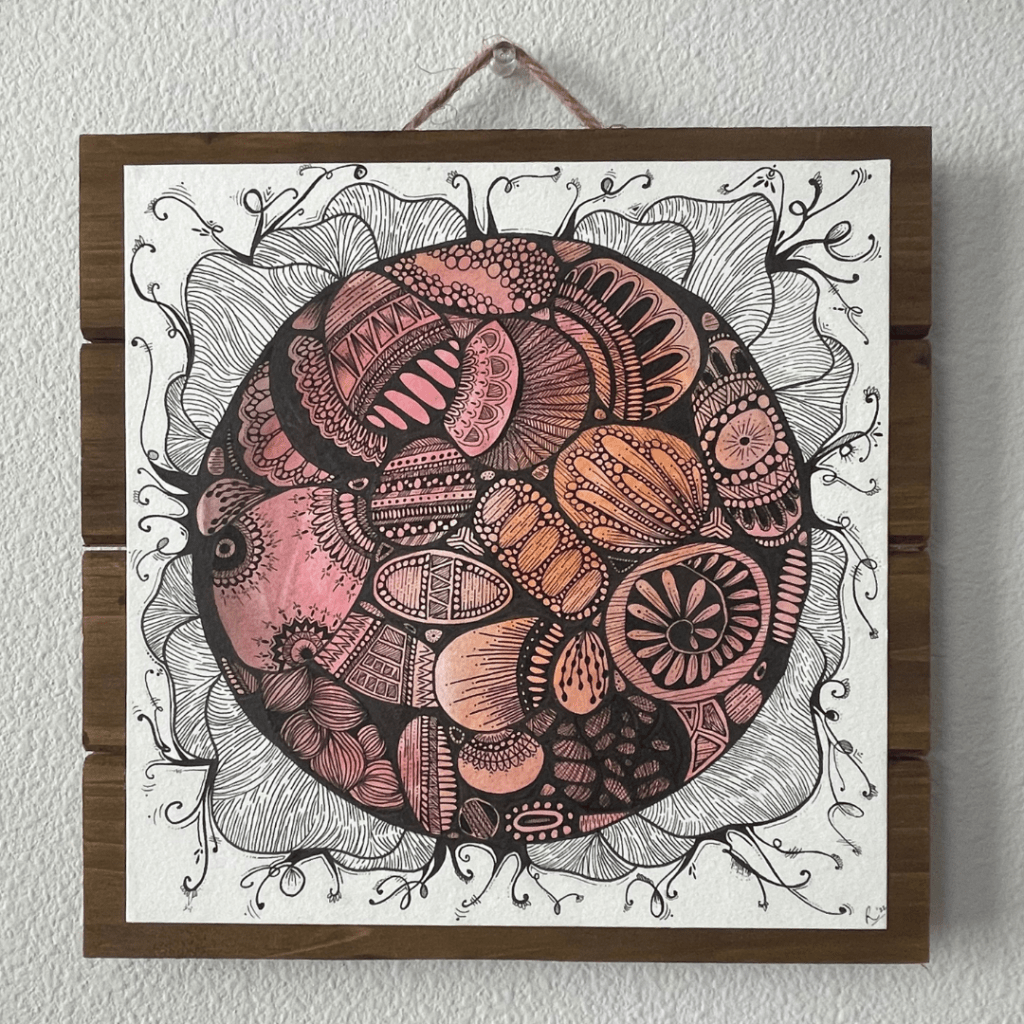
It was one of her first times playing with watercolor, with a pink and orange background—colors she doesn’t normally gravitate toward.
She managed to get the colors to bleed beautifully. Over that background, she created intricate penwork, filled with shapes and patterns. The technique was difficult enough that she hasn’t even recreated it since.
She remembers thinking about every segment of color and wondering whether each one could become its own color. She was also thinking about repetition.
How much is too much? How do you create rhythm without making everything identical? How do you balance uniqueness with structure?
She describes the piece as having a lot less flow, and a lot more thought.
And perhaps that is why she is so proud of it.
It wasn’t just something she made. It was something she figured out.
Learning to let things be imperfect
Her relationship with abstract art goes back further than her current work.
As a child, Raashi hated it when things weren’t in straight lines.
At one point, she moved her bed to an angle because she thought that if the bed itself was angled, it would always be straight.
It is a wonderfully Raashi way of solving a problem.
But somewhere along the way, she discovered that abstract art offered another possibility: Maybe things don’t have to be straight. Maybe they don’t have to conform. Maybe they don’t have to be perfect.
Abstract art can be beautiful precisely because it frees you from expectations.
And that seems to have become more than an artistic principle. It is also a way of living.
The masterpiece she still owes herself
Raashi already knows what the biggest piece she wants to make looks like. She just hasn’t made it yet.
She imagines a big house. A foyer. An entryway. And on the wall, a massive piece of art—perhaps six feet by six feet—that feels like walking directly into a sunset. A sunset made from wood.
Something inspired by her roots in California and the feeling of watching the sun disappear at the end of the day.
The piece would define the room. It would have its own spotlight. And the spotlight might change depending on the mood.
Maybe the artwork would have a story attached to it—the thought that inspired it, the moment that made her want to create it.
Elsewhere in the house would be the art she has collected during her travels. A library. A studio. Smaller things everywhere. But the common spaces would belong to the large pieces.
She doesn’t want the art to merely decorate the room.
She wants the art to define the room.
For now, her artwork is more like a scrapbook—limited by the amount of space and the environment she currently has.
But the dream is much bigger.
What gets in the way
The obstacles are not really about motivation.
They’re practical: Space. Time. Commuting.
Making art on the same table where you cook and eat dinner works for a while. But it isn’t the life she ultimately wants.
She imagines having a studio built into her home. A basement. A garage. A backyard space.
Somewhere she can leave things unfinished. Somewhere materials can stay out. Somewhere making something doesn’t require first clearing away everything else.
Until then, she leans on her self-proclaimed expertise in multitasking. She jokes that her ability to do many things at once has helped her survive the current arrangement.
But there is a difference between surviving and creating freely. She knows that.
A notebook became a future art collection
Perhaps the most powerful story she tells is from a period when creating was not easy.
In 2013, while studying abroad, she loved doodling. When she came home, she redefined what doodling meant to her.
It became something small and portable. A pen. A notebook. Zentangles while traveling.
Something she could do anywhere.
And then, for two years, after breaking her foot in a car accident, that notebook became a place where she could continue to dream and create.
She filled it. Ideas. Patterns. Pieces she wanted to make someday.
Today, many of her larger watercolor and pen pieces are born from those old notebooks.
She goes “shopping” in them for inspiration. The ideas were captured years ago. She didn’t yet have the skills, the space, or perhaps even the time to execute them.
But she trusted that someday she would.
And when that someday arrived, she would simply take those ideas and bring them to life on a larger canvas.
That may be the clearest expression of Raashi’s creative philosophy.
You don’t need to be ready to create.
You don’t need the perfect space. You don’t need the perfect tools. You don’t need to know how to finish the thing.
Sometimes you just need to make the first version.
Don’t let where you’re at stop you
If Raashi could talk to her future self, she says she would probably tell her the same thing she’s been telling herself for years.
The same thing she was telling herself ten or fifteen years ago:
Don’t let where you’re at stop you from creating.
Not the lack of space. Not the lack of access. Not physical limitations. Not the absence of the perfect class. Not even the absence of the right tools.
Take what you have. Make something. Play.
Her two years of filling notebooks are proof that this works. Those little drawings didn’t seem like masterpieces at the time. They were just things she could make.
But years later, they became the source material for bigger works.
The limitation didn’t prevent the art. It became part of the art’s history.
Maybe she doesn’t need a masterpiece
There is a temptation, when talking about creativity, to turn everything into a lesson about discipline.
Create every day. Finish what you start. Master your craft. Take the class. Become better.
Raashi doesn’t seem particularly interested in that version of creativity.
She wants to play. She wants to discover. She wants to look at something beautiful and wonder whether she can make it.
She wants to try a technique, get frustrated, switch mediums, learn something new, and come back later.
She wants to make something simply because an idea won’t leave her alone. And maybe that’s the thing worth remembering.
Not every idea needs to become a masterpiece. Not every creative act needs to become a skill. Not every hobby needs to become a career.
Sometimes the point is simply to follow the curiosity far enough to find out where it leads.
Raashi is still figuring out what brings joy into her life. Maybe that’s why she creates.
Not because she has figured it out.
But because creating gives her another way to keep figuring it out.
And somewhere between the notebooks, the watercolor, the acrylics, the dried flowers, the fantasy novels, the imaginary sunsets and the art she has yet to make, there is a philosophy taking shape:
Don’t wait for the perfect conditions to become the person you want to be.
Take what you have.
Make something.
And keep playing.
To learn more about Raashi and her art journey follow her on below inks
- Website: voraxious.com
- Instagram: @voraxious_creations, @raashib23

